

Lowering the Volume
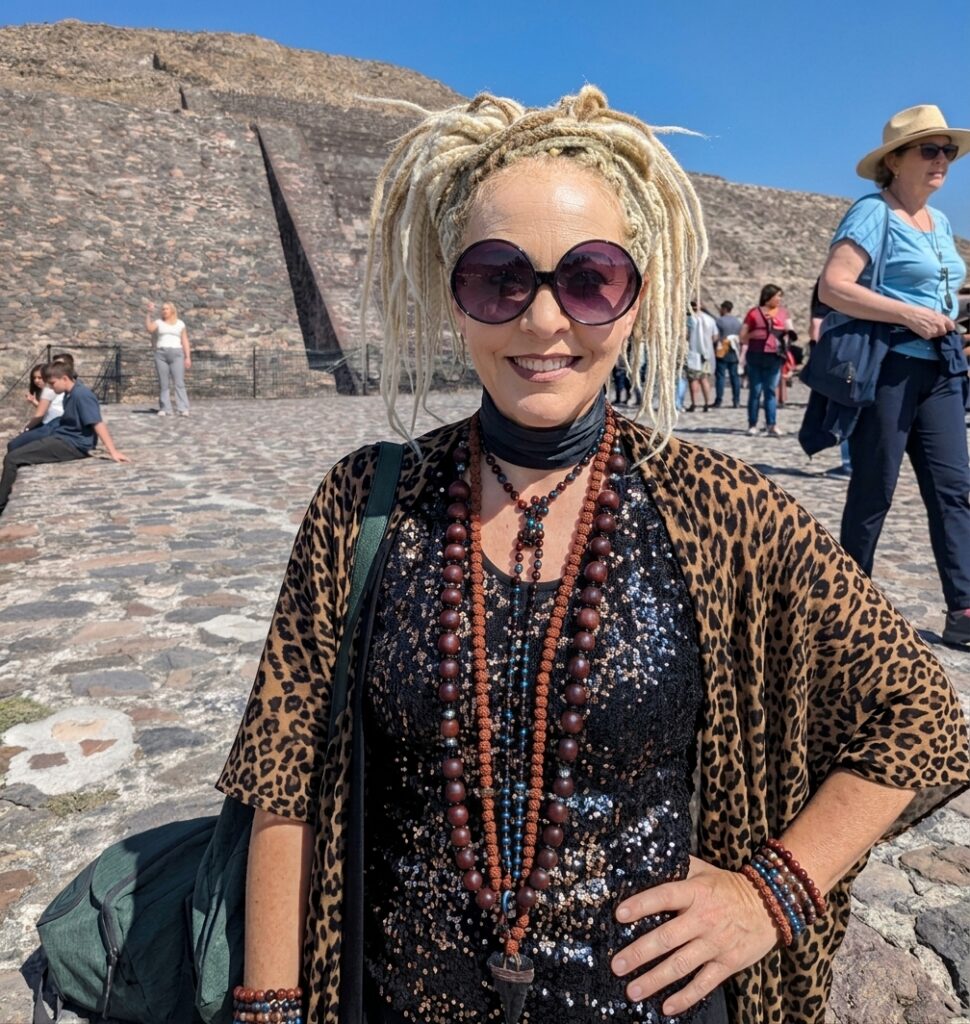
Marni Hills left Los Angeles and the hamster wheel behind. In San Miguel de Allende she found a quieter way to live, and a QHHT practice built almost entirely on listening.
Quantum Healing Hypnosis Technique (QHHT) · Radical Listening · Consciousness Exploration
Ask Marni Hills what Mexico taught her, and the answer comes quickly: to lower her volume. Visiting gringos, she points out, can be heard from hundreds of feet away. Stay long enough and you learn that loud talk reads as gauche here, and you bring your voice down to meet the people you’re speaking with.
It’s a small adjustment. It’s also, in its way, the whole of her work.
As a Quantum Healing Hypnosis Technique (QHHT) practitioner in San Miguel de Allende, Marni spends much of every session saying very little. She listens, for hours, while clients tell the story of their lives. Then she guides them somewhere quieter still.
From the Border Towns to the Bajío
Marni has been travelling through Mexico since the 1990s, back when the border towns held a particular pull for a young person: a looseness, a near-lawlessness that felt exhilarating. She grew up. And slowly she began to recognize everything else the country held.
Los Angeles, meanwhile, was getting harder to justify. Staying meant working harder just to stand still, and Marni refused to run faster on the hamster wheel to keep the status quo. She started thinking about a life outside the United States, and Mexico stood out obviously. Each time she flew home from a trip, a deep sadness came with her. The pandemic made the question impossible to set aside: where, and how, did she actually want to live?
The answer was San Miguel de Allende.
The Desile That Still Stops Her

Of everything that surprised her here, one thing returns every year: the desfile of the Fiesta de la Santa Cruz del Valle del Maíz. The costumes. The traditional creations. The drumming that doesn’t let up. And above all, the seriousness of it. This is not a show put on for visitors. It is something older, held with intent, and she says it still blows her mind every single year.
She met that same intensity in the temazcal. On the outskirts of Mexico City, Marni has sat through a couple of fierce sweat lodge ceremonies that she describes as profound, and a genuine challenge to her comfort zone.
A Path She Didn’t See Coming
For most of her life, Marni’s path ran toward animals, and dogs in particular. Hypnosis wasn’t anywhere on the map. Then, after moving to Mexico, she came across the work of Dolores Cannon, the founder of QHHT, through programming on the Gaia channel, and booked a session for herself.
What she experienced was profound enough to change direction. She was guided toward helping others explore their own consciousness, and the work that followed has become the most meaningful thing she does.
“All hypnosis is actually self-hypnosis, and I am just a guide. You will experience exactly what you need at this time.”
Inside a QHHT Session in San Miguel
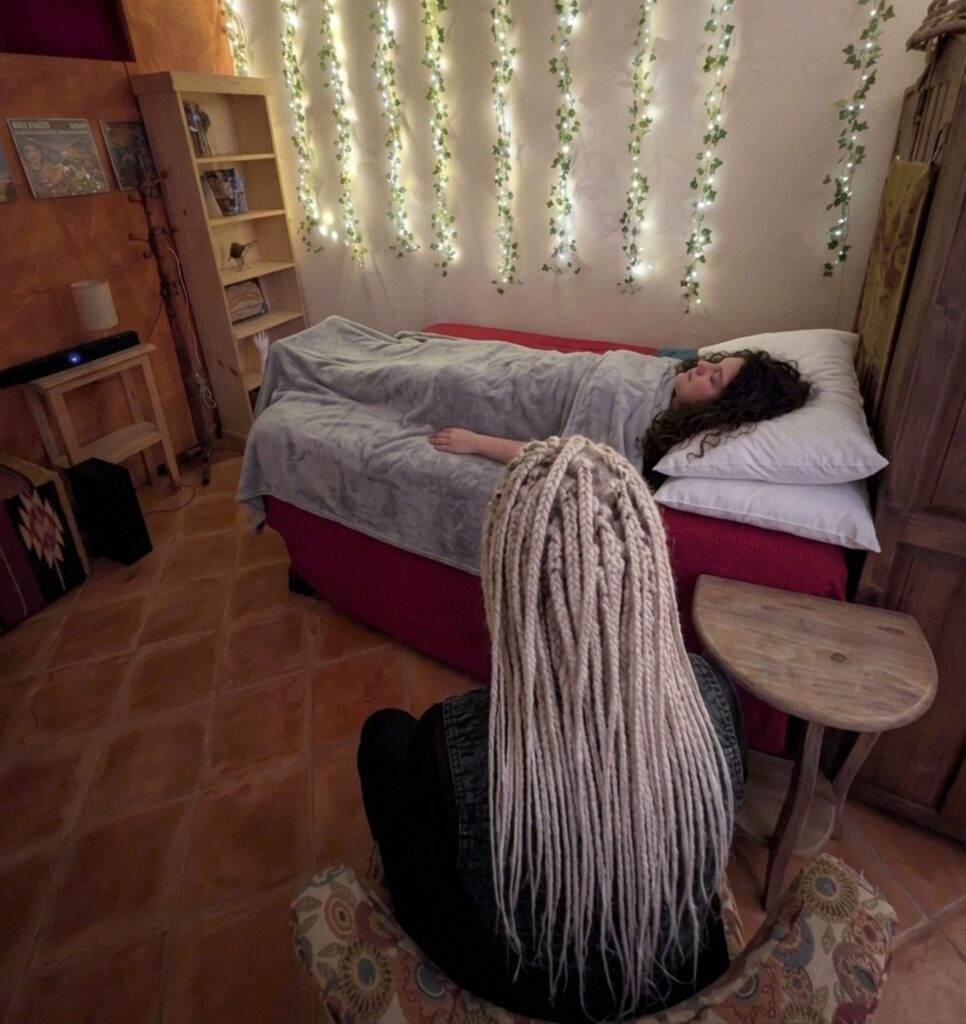
A QHHT session in San Miguel with Marni is not an hour on a couch. It takes most of a day.
Clients arrive in the morning. After walking through how the process works, Marni invites them to tell their life story, from childhood to the present. That telling can run three or four hours, and she meets it with what she calls radical listening: no judgment, no feedback, only the occasional question to clarify. It’s often here, before any hypnosis has begun, that something shifts. A client stops mid-sentence and sees a connection for the first time. “I never realized that until just now,” they tell her, and that realization, she says, is healing in itself.
After a break, they go over the questions the client has brought. Then the client lies down, and Marni guides them into a deeply relaxed theta state through visualization, a portion that runs an hour and a half to two hours or more. What happens next is different for everyone: healing in fields of color or in a quiet void, a childhood scene, a past life, or a metaphor that only makes sense later.
Finally, Marni asks permission to speak with the client’s Higher Self, which she describes as a loving energy that knows everything that has ever happened to you and wants what is best for you. She asks why the client was shown what they saw, and then she asks their questions. Every session, she says, surprises her.
Once, it surprised her more than usual. In QHHT the practitioner is only a guide; the session is never about her. But during a recent session, the client’s Higher Self addressed Marni directly, acknowledging her and the work they were doing together. It is rare, and she was floored. If anything, it deepened her commitment to the work.
A Pure Method, A Mexican Room
QHHT is a precise method, and Marni is careful never to modify it or fold in other practices. But Mexico is in the room all the same: local artwork, stones, the smoke of copal. The method stays pure. The space around it has taken root here.
Chop Wood, Carry Water
Marni’s philosophy is refreshingly unsentimental. A session, a workshop, good advice: none of it changes anything unless you take it home and build it into your habits. Chop wood, carry water. Transformation takes consistent practice and commitment, often longer than people expect. Yet once the practice takes hold, she’s found, changing yourself is often easier than you’d think.
That’s why, in her experience, the people who get the most from QHHT are those who can release their expectations, hold a “what if?” mindset, and take the follow-up work seriously.
Her own guiding principle is simple: be a calm, peaceful observer, and don’t react from fear or judgment. She keeps exploring consciousness through Monroe Institute programs, IONS webinars and meditation, and she returns again and again to the simplest practice she knows: grounding, bare skin on bare earth. It costs nothing, she notes, and almost no one does it.
“If you can make yourself sick, holding on to rage, shame, guilt, trauma, you can also make yourself well.”
A Perfect Day in San Miguel

Marni’s ideal day begins with a three-mile walk with her dogs through the fields near El Charco and down to Parque Landeta. Then on to La Plazita, what locals call the Tuesday tianguis, for palo azul tea, coconut dulce and a dig through the clothing stalls. Lunch is an hour of sun in her courtyard with the dogs. Later comes altering and reinventing whatever she found at the market, or a little painting, or some writing.
When friends visit, she takes them somewhere they’d never stumble on alone: a private balcony table at Hotel Boutique Casa Angelitos in Atascadero, looking out over the city, with a farm-to-table breakfast at a very gentle price.
And before anyone leaves Mexico, she hopes they’ll catch one of the desfiles, the Fábrica art walk, or a Día de Muertos celebration.
It suits a woman who learned to lower her voice in Mexico that she now spends her days listening. In San Miguel, Marni Hills has found a home and a practice that ask the same thing of her: get quiet enough, long enough, and the answers people need tend to surface on their own.

Marni Hills offers individual QHHT sessions (4–6 hours), 60- and 90-minute group sessions, and gift certificates in San Miguel de Allende.
Learn more on her EnForma profile and book through the EnForma app.
Explore more practitioners in our San Miguel alternative therapies directory https://sanmigueldeallende.enformawellness.com/alternative-therapies].
EnForma was born in Mexico. Not inspired by it, not transplanted here — born here, in the salt air and slow mornings and something harder to name that this country does to the people who stay. Raíces is our way of introducing you to the people who know that feeling best: the practitioners who came to Mexico and never left, who built their practices here, who found in this land a deeper expression of the work they were already called to do. Each post in this series is a conversation — about healing, about Mexico, about what it means to root yourself somewhere and let that place change you.

