


The Music That Interrupted the Pain
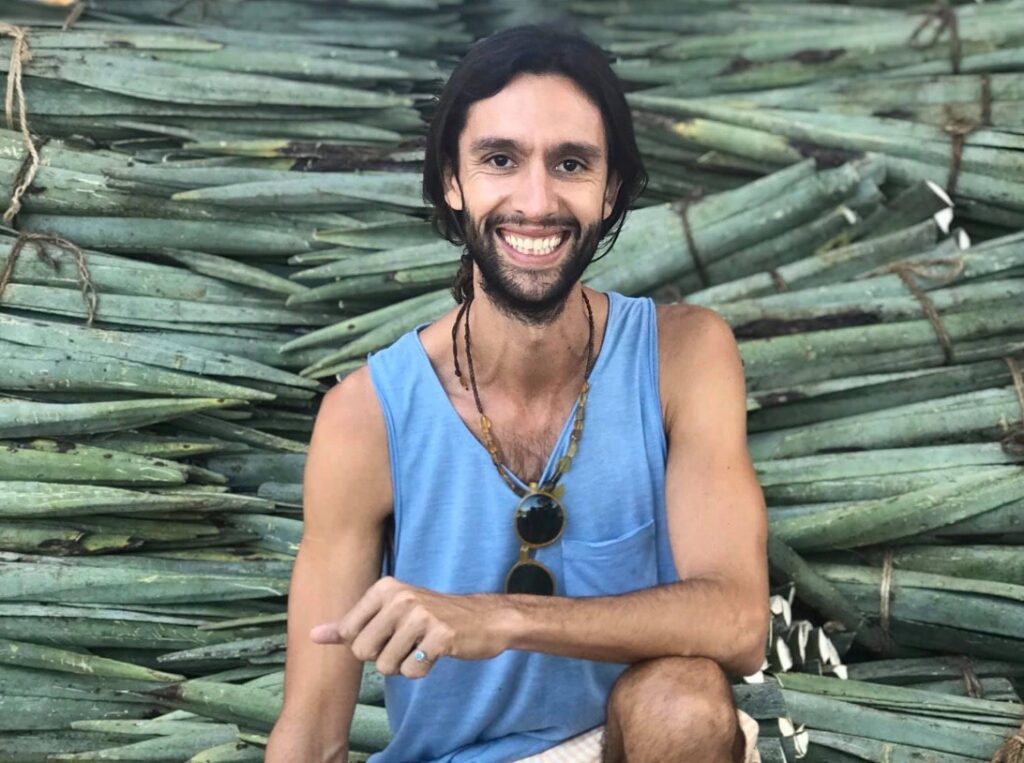
After years believing his body was broken beyond repair, and in chronic pain, JP Stones found the first real evidence otherwise — alone at home, dancing to a song that made him forget.
JP Stones has lived in Mexico for twelve years. He and his now-wife arrived after stepping away from the corporate world, expecting only to pass through. They never left.
What held them, he says, was the warmth, the openness, the absence of ego. People felt approachable here. Life seemed less interested in the conventional scorecards of success — the ones he had spent years playing by without asking why. For the first time, he found permission to listen to what his heart and body actually needed, instead of continuing to operate like a machine.
That permission turned out to be the beginning of everything. Since arriving, JP has lived an unusually creative life, including years of work as a fine-art cultural photographer. But underneath the creative work, something more difficult was unfolding. He was beginning to recover from what had become debilitating chronic pain and anxiety. That recovery has been long, strange, and still ongoing. And it eventually became the foundation of the work he does today.
THE MOMENT THAT CHANGED EVERYTHING

For years, JP believed his pain came entirely from damaged muscles, tendons, and bones. He could barely walk. The only path he could imagine was to keep trying to fix those structures, one treatment at a time — another stretch, another adjustment, another specialist promising the piece the last one had missed.
Then something happened that didn’t fit the story.
Alone at home, feeling safe, the right song would sometimes come on. He would get absorbed in the music and find himself dancing — moving in ways he had believed his body could no longer do. For those minutes, he forgot he was a chronic-pain sufferer at all. His body simply moved, the way it once had, before pain became the thing that defined it.
Then he would remember. And the pain would return.
“That experience did not mean the pain was imaginary. It showed me that something far more complex was happening.”
He saw his first real evidence that attention, safety, and emotion could change what his body was capable of. It was not proof that the pain was fake, but proof that it wasn’t purely mechanical either. That single contradiction eventually reshaped his entire understanding of pain, and of himself.
WHAT MEXICO TAUGHT HIM ABOUT HEALING

JP has noticed a pattern in the people who arrive here: something in them loosens. They become more open, more curious, more willing to play.
Those qualities, he has learned, matter enormously in nervous-system work. Healing is difficult when people treat themselves as a problem to be solved or a project to optimize. Curiosity creates the room that fixing does not.
“Mexico seems to help people loosen their grip on certainty and become more receptive to what their bodies might be telling them.”
He believes the wellness culture here is still finding its shape — and that its future depends on staying curious enough to hold both ancestral wisdom and modern science without turning either into dogma.
A NERVOUS SYSTEM, NOT A MACHINE
JP now works with people living with chronic conditions — persistent pain, and the anxiety, insomnia, digestive trouble, overwhelm, and fear that so often travel with it.
His framework starts with a reframe: the nervous system is a prediction machine. When it has spent years anticipating danger — from major experiences or from thousands of smaller pressures accumulated over time — it can get stuck in patterns of protection. Anxiety keeps the system scanning. Muscles stay guarded. Sleep grows difficult. Pain keeps demanding attention it was never actually asking for.
His work draws heavily on Pain Reprocessing Therapy (PRT) and Emotion Awareness and Expression Therapy (EAET), both of which have strong emerging evidence in chronic pain treatment. He is EAET-certified, and folds in nervous-system education, movement, breathwork, mindfulness, and emotional work according to what each person in front of him needs.
No two sessions look alike, because no two nervous systems are alike. His early task with a new client is finding the most accessible doorway in. Is it movement, breath, meditation, sensory awareness, or simply an explanation of what the system is actually doing. He doesn’t start from a fixed modality. He starts by learning how someone responds to the world, which senses they connect with most easily, and what capacity their system has on that particular day. As the person changes, session by session, the direction can change too. The work stays dynamic because the nervous system in front of him is never quite the same one twice.
RECLAIMING ATTENTION
If there is one idea underneath all of JP’s work, it’s this: regulation means reclaiming attention.
“Pain pulls at our attention. Anxiety pulls at our attention. Both can keep reinforcing the prediction that the world — or the body — is dangerous.”
Learning to spend time in the body without immediately treating it as a threat can begin to shift those predictions. This isn’t about forcing calm, or pretending symptoms away. It’s about giving the nervous system new evidence, gradually, until it starts to believe something different — the same kind of evidence a certain song once handed him, one dance at a time.
WHY HERE
Mexico taught JP that there is more to a life than conventional success and material accumulation. It taught him to create, to listen, and to let life unfold without needing to control every part of it.
That lesson shows up in how he works as much as in how he lives. He no longer approaches the body as a machine to be fixed once and left alone — he approaches it the way he has learned to approach his own life here: with attention, with patience, and with room for it to keep changing.
He hopes the wellness community here stays open and exploratory even as it grows more grounded, collaborative, and evidence-aware. There is no single method that works for everyone — and the strongest community, in his view, will be the one curious enough to hold both traditions, ancient and modern, without needing to defend either one.
JP Stones is a chronic pain and nervous-system coach based in Sayulita and founder of the Chronic Conditions Clinic. He is EAET-certified and draws on Pain Reprocessing Therapy and Emotion Awareness and Expression Therapy to work with clients living with persistent pain, anxiety, and the nervous-system patterns that often accompany them.
Find JP Stones on the EnForma Wellness platform and book a session through the EnForma app.
EnForma was born in Mexico. Not inspired by it, not transplanted here — born here, in the salt air and slow mornings and something harder to name that this country does to the people who stay. Raíces is our way of introducing you to the people who know that feeling best: the practitioners who came to Mexico and never left, who built their practices here, who found in this land a deeper expression of the work they were already called to do. Each post in this series is a conversation — about healing, about Mexico, about what it means to root yourself somewhere and let that place change you.

